
How to Build a Four-Generation Family Tree: A Complete Guide from Grandparents to Grandchildren
Many Chinese families value the tradition of having four or more generations living in close connection. When you try to document this in a family tree, you quickly discover that the number of members grows fast and the relationships become complex.
This guide provides a practical approach to building a four-generation family tree, from collecting the data to choosing the right display format.
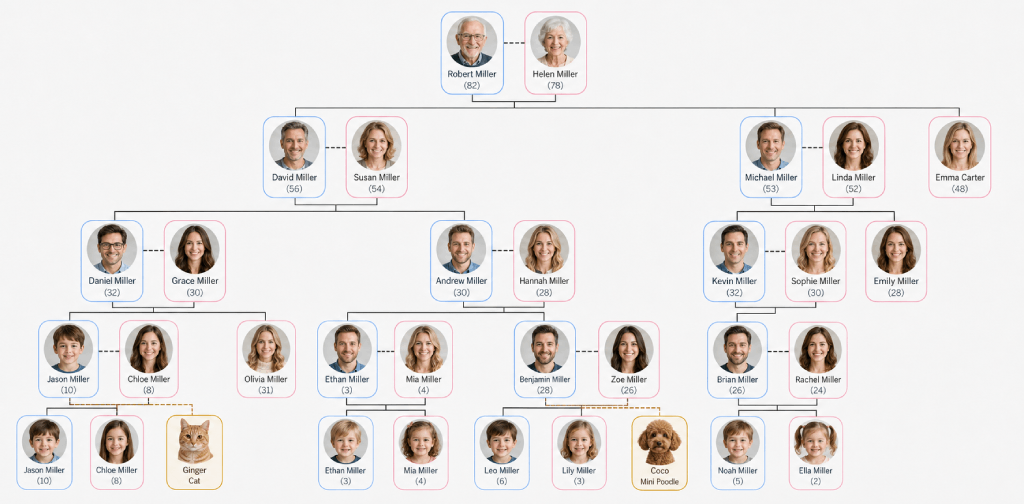
The Basic Structure of a Four-Generation Tree
A standard four-generation family tree is organized top-to-bottom into four levels:
- First generation (top): Great-grandparents (paternal and maternal)
- Second generation: Grandparents (paternal and maternal)
- Third generation: Parents and their siblings (aunts, uncles)
- Fourth generation (bottom): Yourself and siblings, plus cousins
Lines connecting parents to children are drawn vertically (blood relationships), while spouses are connected horizontally, usually with different line styles — solid for blood relatives, dashed for spouses.
Where Should You Start?
Start from your own generation (the fourth) and work upward:
- You know your own generation's data best
- You can verify older generations by asking older relatives
- Leave unknown ancestors blank and fill them in as you learn more
How to Handle Multiple Spouses
In traditional Chinese families, it's not uncommon for earlier generations to have had multiple spouses. For these cases:
- Arrange spouses left to right in chronological order (first spouse on the left)
- List each spouse's children separately under their respective parent
- Note the marriage order (e.g., first wife, second wife) in the record
Step-by-Step: Building Your Four-Generation Family Tree
Step 1: Collect Your Data
List members for each generation:
- First generation: Great-grandparents' names and dates
- Second generation: Grandparents' names, dates, and siblings
- Third generation: Parents' names and siblings (aunts/uncles)
- Fourth generation: Yourself, siblings, and all cousins
Step 2: Draw the Main Trunk
Start with your direct line of descent: Great-grandparent → Grandparent → Parent → You
Step 3: Add Branches
Add siblings at each generation:
- First generation: Great-grandparent's siblings (if known)
- Second generation: Grandparent's siblings (great-aunts and great-uncles)
- Third generation: Parent's siblings (aunts and uncles)
- Fourth generation: Your own siblings
Step 4: Add Spouses
Add a spouse next to each member, connected by a dashed line or a different color.
Step 5: Connect Children
Below each couple, list their children and connect them with vertical lines.
Why Digital Tools Make This Easier
Trying to draw a four-generation family tree on paper quickly runs out of space and becomes tangled. Digital family tree tools offer:
- Automatic tree visualization and layout
- Easy addition of new members without redrawing
- Search to quickly find any person
- Zoom and pan to navigate a large multi-generational tree
- Collaborative editing so multiple family members can contribute
Rootrees supports multi-generation family trees with visual display centered on any member. For families with multiple spouses or complex relationships, Rootrees provides full support for recording these accurately.
Common Questions
Q: What if I don't know my great-grandparents' information?
That's fine — leave those spots blank and fill them in later as you learn more. You can always add a note like "unknown" or "to be confirmed."
Q: Should I include both paternal and maternal sides?
A complete family tree includes both sides. If space or data is limited, start with one side and add the other later.
Q: How do I handle adopted or foster family members?
Record them as members and mark the relationship as non-biological. Add a note to explain the background. Adopted and foster children occupy the same generational position as biological children.
Summary
A four-generation family tree works best when it's organized clearly by generation. Start with your direct bloodline, then add siblings and spouses layer by layer. Missing data is normal — family trees are living documents that grow over time, and adding a little more information each year is the best way to preserve your family history.