
How to Create a Family Tree: Start by Organizing Your Family Data
The first step to building a family tree isn't drawing a diagram — it's organizing your family data. Many people jump straight into drawing and quickly get stuck because information is incomplete: a grandparent's birthday is missing, a spouse's name is forgotten, or they're unsure how to describe a complex relationship.
This guide covers the most common challenges in building a family tree and provides a practical step-by-step approach to help you go from data collection to a complete family tree.
Why Organize Data First Instead of Drawing Right Away?
A family tree is essentially a visualization of data. If you start drawing without complete information, you'll often need to make extensive changes later, which can make your tree structure messy and confusing.
The benefits of organizing data first include:
- Identifying missing members early
- Making it easier to verify information with relatives
- Speeding up data entry when using a digital tool
- Making future updates (births, deaths) much easier to manage
What Data Should You Collect?
Start by gathering these basic fields for each family member:
- Full name (including maiden names for married women)
- Birthday (Gregorian or lunar calendar)
- Gender
- Spouse(s) (list multiple spouses in chronological order)
- Parents (father and mother separately)
- Children (in birth order)
- Living or deceased (if deceased, record the date of death)
- Notes (e.g., adoption, foster care, migration details)
If older relatives are still alive, this is a great opportunity to sit down with them and collect information while listening to family stories.
How to Organize by Generation
Start with yourself and expand one generation at a time:
- Your generation: yourself, siblings, spouse, spouse's siblings
- Parents' generation: your father, mother, aunts, uncles
- Grandparents' generation: paternal grandparents, maternal grandparents
- Children's generation: your children, nieces, nephews
You don't need to complete everything at once. Start with what you know and fill in the rest gradually.
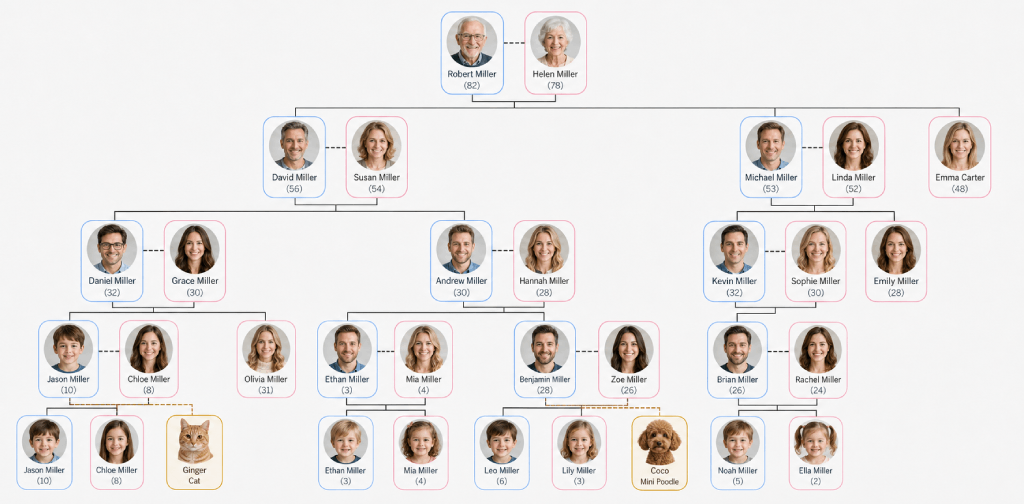
What About Lunar Calendar Birthdays?
Many Chinese families record birthdays using the lunar calendar (農曆). If an elder's birthday is only known in the lunar calendar, record it as-is and convert it to the Gregorian calendar later using a conversion tool — or use a family tree app that supports both calendar systems simultaneously.
Some apps also support leap months (閏月) in the lunar calendar, which is important for accurately representing traditional Chinese birth dates.
How to Record Non-Biological Relationships
In many traditional Chinese families, there are cases of adoption, fostering, or historically common practices like informal child transfers between families. These members are still part of the family and should be recorded in full, with a note explaining the nature of the relationship.
Most modern family tree apps support marking a relationship as "non-biological" and adding a free-text note to clarify the background.
After Organizing Your Data — What's Next?
Once you have your basic data organized, you can start using a digital tool to build your family tree. Your options include:
- Paper sketches: Traditional approach, suitable for small families
- Spreadsheets: Great for data-oriented people, but hard to visualize
- Family tree apps: Most practical option, with built-in tree visualization, sharing, and collaboration
If you want to build a digital family tree you can share with family members from your phone, Rootrees is a family tree app built specifically for Chinese families. It supports the lunar calendar, traditional birth hours (時辰), multiple spouses, and non-biological relationships — so you can record your family history completely and accurately.
Summary
The most important first step in building a family tree is organizing your data. Start with yourself and your parents' generation, and gradually expand upward. Once your data is organized, using a digital tool to create a visual family tree becomes much smoother and more enjoyable.